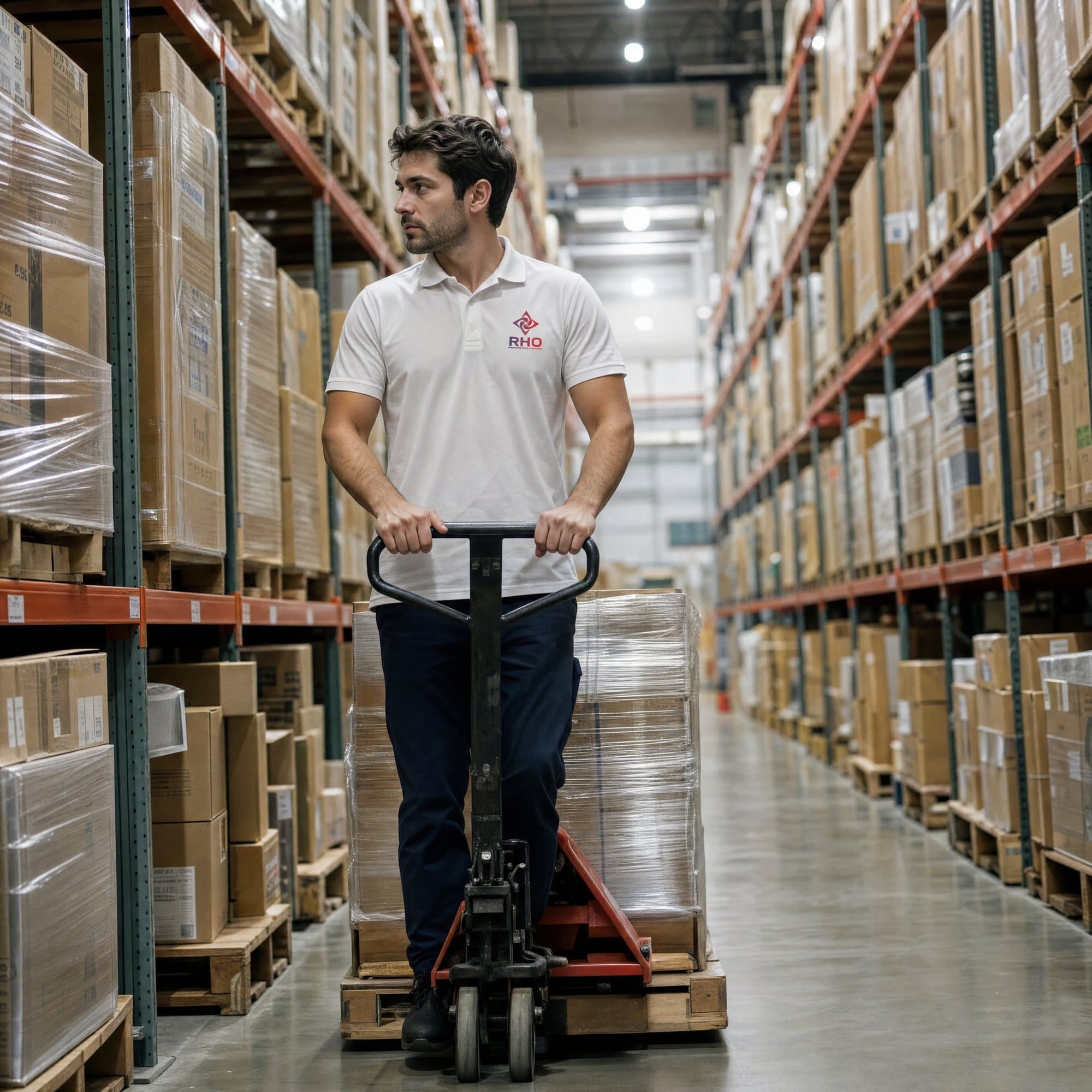

In short: OSHA's forklift rule, 29 CFR 1910.178(l), requires that each operator be trained and then evaluated in the actual workplace where he or she will drive, before driving there. Each employer must certify that both training and evaluation took place, and each operator must be evaluated again at least every three years. When using a temp operator, the responsibility is shared by both the agency and host employer. RHO Hiring has forklift operators available to work in Metro Detroit warehouses and plants: apply for forklift operator jobs or call us at (248) 843-0000.
That joint responsibility is where most of the confusion resides. OSHA views the staffing agency and the host employer as joint employers: the agency is typically responsible for the generic training and the host provides the site-specific training and the workplace evaluation. A temp operator can show up with years of experience and a card from a previous employer and still not be qualified to drive on a new floor until evaluated there.
What does OSHA require for forklift training?
The standard places the responsibility on the employer: Each operator must demonstrate that he or she is competent to operate a powered industrial truck safely. This competence is demonstrated by successfully completing the training and evaluation specified in the rule. Before then, an operator in training may operate a truck only if that operator is being directly supervised by someone with the knowledge, training and experience to train operators and evaluate their competence, and only where the training does not put the operator or anyone else at risk.
| Requirement | What the rule says | Paragraph |
|---|---|---|
| Competence | Demonstrate competence to safely operate the truck, as shown by completed training and evaluation. | (l)(1)(i) |
| Before operating | Complete training prior to operating a truck, unless under direct supervision while training. | (l)(1)(ii) |
| How training is done | Formal instruction and practical training, along with on-the-job evaluation of operator performance. | (l)(2)(ii) |
| Who trains | People with the knowledge, training and experience to train operators and evaluate their competence | (l)(2)(iii) |
| Refresher training | Following an incident involving unsafe operation, an accident or near miss, a negative evaluation, a new type of truck, or a change in workplace conditions. | (l)(4)(ii) |
| Re-evaluation | At least once every three years | (l)(4)(iii) |
| Certification | Operator name, training date, evaluation date, and who did the training or evaluation | (l)(6) |
In one sentence, OSHA's forklift topic page says employers must ensure each operator is competent to run a forklift, as demonstrated by successfully completing the training and evaluation specified in 1910.178(l)(1). The one word that matters is "and." Training alone doesn't count without the evaluation.
What does OSHA forklift training cover?
The standard contains two lists of topics: one for the truck, the other for the workplace. The employer may delete a topic only if it can demonstrate that the topic is not relevant to the safe operation of the truck in the workplace.
The truck
Operating instructions and warnings, controls and instruments, steering, visibility, forks and attachments, capacity and stability.
Daily care
Any required operator inspections and maintenance, plus refueling or charging and recharging batteries.
The floor
Surface conditions, pedestrian traffic areas, tight aisles and other restricted places, ramps and inclines.
The loads
Construction of loads, stability of loads, and safe handling of loads including stacking and unstacking.
The air
Enclosed spaces where carbon monoxide or diesel exhaust could accumulate due to poor ventilation or truck maintenance.
The manual and the rule
Everything else listed in the operator's manual for that particular type of truck, and the mandates of the standard itself.
There is one exception to the rule. If an operator has already received training in a subject and the training was applicable to the truck and working conditions under which they will be working, then that training subject does not have to be repeated provided that the operator has been evaluated and determined competent to safely operate the truck. Previous training can save time. It does not negate the need for an evaluation.
Who trains a temp forklift operator, the agency or the host?
They both do. OSHA's Temporary Worker Initiative bulletin about powered industrial truck training states that when an agency provides temporary workers, the agency and its client, the host employer, are usually joint employers. Therefore both are responsible for ensuring that the worker is properly trained. They can split the responsibility up between them, and OSHA recommends that they put that split in writing in their contract. However, neither employer may contract away its responsibility by requiring the other employer to perform the task.
| Task | Staffing agency | Host employer |
|---|---|---|
| Generic training on the type of truck | Generally responsible | Verifies the training |
| Site-specific training: your trucks, aisles, docks and traffic | Asks about it and checks it's adequate | Generally provides it |
| Workplace evaluation before operating | Makes sure it happens | Conducts it for each supplied operator |
| Refresher training after an incident | May recommend it | Usually decides on it and provides it |
| Training and evaluation records | Often best placed to keep them | Must know where they are; must be accessible to OSHA if they do an inspection. |
| Re-evaluation at least every three years | Shared duty | Shared duty |
The bulletin is quite clear about supplied operators. If the supplying agency furnishes trained operators, the host still has to confirm that training, provide site-specific information and training regarding its trucks and conditions, and perform a workplace evaluation of each operator. How much training the host adds will vary depending on the experience of the operator, and they may not have to go through the entire initial program. The site-specific training and evaluation should be commensurate with that provided by the host to its own employees in the same jobs.
The agency also has responsibilities. It must take reasonable steps to inquire about the host's training program, and it must have a reasonable basis to believe that the program trains for the hazards its employees will encounter. If the agency finds out its workers are driving trucks when not properly trained, OSHA says it should notify the host and let the host provide the training, provide the training itself, or remove its employees from the job site.
How it goes wrong: OSHA's own example
One scenario presented in the bulletin is worth reading. A distribution company, referred to as MWC in the bulletin, requires additional workers to cover a surge period. MWC contracts with what the bulletin refers to as Temp Staffing to provide five workers who are already trained on sit-down order picker trucks. Temp Staffing and MWC meet before work starts to discuss the jobs and equipment. Upon arrival at the facility, an MWC supervisor reviews the warehouse layout, the traffic patterns, loading procedures and seat belt requirements with the temps.
A few days later one of the workers turns too sharply around a corner because his view is blocked by an excessively tall load. He runs into a stack of pallets. Nobody gets hurt, but one pallet gets knocked over. OSHA's take: both companies could receive citations. MWC provided site-specific training but never evaluated whether the workers were competent operating its trucks, and the agency may not have trained them adequately or ensured the evaluation took place. They discussed training and job tasks, but never discussed evaluation, and that is precisely where the breakdown occurred.
Forklift certification in Michigan: check MIOSHA's rules too
Private-sector workplaces in Michigan, with certain exceptions, fall under the jurisdiction of the Michigan State Plan, administered by the Michigan Occupational Safety and Health Administration (MIOSHA), part of Michigan's Department of Labor and Economic Opportunity. According to OSHA, MIOSHA has incorporated many federal standards by reference; however, it has developed some requirements that are different from those of federal OSHA. OSHA lists materials handling as one of the general industry areas where Michigan's requirements differ. Compare MIOSHA's version with 1910.178. MIOSHA also offers on-site consultation services for employers.
Before a temp operator drives on your floor
OSHA forklift training questions
Does a forklift card from another job mean an operator can drive at a new site?
No, not automatically. Previous training may count if it is applicable to the trucks and conditions at the new site. However, the operator must still receive training specific to the new site and be evaluated in that setting. The employer is responsible for certifying that both the training and the evaluation were completed.
How often do forklift operators need to be evaluated again?
Operators are evaluated at least every three years. Refresher training is given if an operator drives unsafely, is involved in an accident or near miss, receives an unsatisfactory evaluation, transfers to another class or type of truck, or if there are changes at the workplace that affect safe operation.
Who keeps the records for a temp operator?
Either employer may house them, and often the agency supplying trained operators is best situated to do so. The host facility must be aware of their location, and they must be accessible to an OSHA compliance officer during an inspection.
Do powered pallet jacks and order pickers count?
Yes. Forklifts, fork trucks, lift trucks, pallet jacks and order pickers are all powered industrial trucks according to OSHA's bulletin, whether they are ridden by the operator or used with the operator walking alongside.
Who should I call for forklift operators, or for forklift work, in Metro Detroit?
Contact a temp agency that places forklift operators and agrees with you on who provides training and evaluation. RHO Hiring provides forklift operators to warehouses and plants throughout Metro Detroit. RHO Hiring also trains its workers on safety prior to their first day of work. Both employers and operators seeking employment can call (248) 843-0000.
How RHO Hiring supplies forklift operators in Metro Detroit
RHO Hiring provides forklift operators to warehouse and plant facilities throughout Metro Detroit. We take the time to learn about your trucks, shifts and volume before anyone starts so we can place operators on the equipment you use, and we train our workers on safety prior to their first shift. We will walk you through who is responsible for what part of the training and evaluation process so that there are no gaps between us. Please refer to our warehouse staffing guide for the other positions on the floor.
Sources

Next guide
How to choose a staffing agency: do it before your first employee punches in, because that's where the majority of staffing issues begin. Eight questions you should ask every agency, examples of good answers including RHO Hiring's own, and warning signs to look out for.